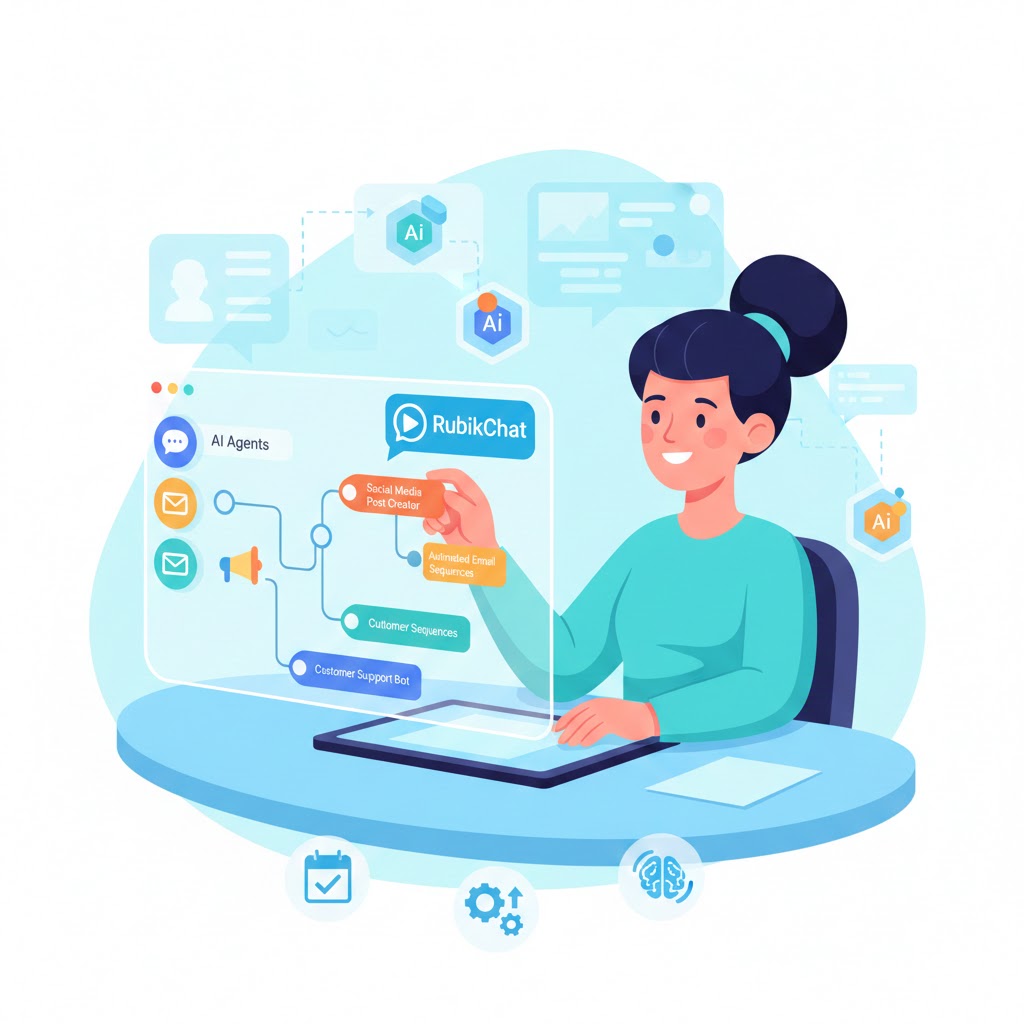
AI Agents in Software Development
Artificial Intelligence (AI) is transforming industries, but not all AI systems work the same way. Among the most innovative solutions are AI agents, which are distinct due to their ability to act autonomously, adapt dynamically, and achieve specific goals.
For instance, a software development team struggling with repetitive coding tasks can leverage an AI agent builder. The AI agent can suggest code improvements, detect errors, and even automate deployment workflows—tasks that traditional AI systems analyze but rarely execute independently.
Understanding AI Agents
AI agents are autonomous software systems designed to perform tasks, make decisions, and interact with users or other systems without constant supervision. Unlike conventional AI, AI agents are:
- Autonomous: Operate independently once configured via an AI agent development platform.
- Goal-Oriented: Designed to achieve specific objectives, like automating customer support or improving software development workflows.
- Adaptive Learning: Continuously evolve based on interactions and new data.
- Interactive: Communicate with humans and software systems to improve efficiency.
Example: A software development services company implemented an AI agent using RubikChat to monitor project progress. The agent identified bottlenecks, suggested corrective actions, and reassigned tasks automatically, saving the team significant time.
Key Differences Between AI Agents and Traditional AI
|
Feature |
Traditional AI |
AI Agents |
|
Decision-Making |
Limited, human-supervised |
Autonomous, can make proactive decisions |
|
Purpose |
Data analysis or prediction |
Solves problems and achieves goals via AI agent development |
|
Adaptability |
Needs retraining |
Learns continuously from interactions |
|
Interaction |
Passive output |
Engages actively with users or systems |
|
Use Cases |
Analytics, predictions |
AI agent builder tools, virtual assistants, workflow automation, coding assistants |
These differences explain why AI agents are now essential for software development services companies, providing both efficiency and smarter decision-making.
Real-Life Examples and Case Studies
- Software Development: A software development services company used an AI agent to analyze a codebase, identify vulnerabilities, and suggest optimizations—reducing human errors by 30%.
- Education Tech: A virtual tutoring agent, developed through an AI agent builder, assesses student performance and creates personalized learning paths.
- Business Operations: AI agents monitor workflows, predict bottlenecks, and trigger corrective actions automatically.
Practical Tips for Implementing AI Agents
- Identify Key Processes: Start with repetitive or error-prone tasks, like coding, testing, or customer support.
- Define Goals: Set measurable objectives for your AI agent development project.
- Use Quality Data: Ensure AI agents learn from accurate, relevant datasets.
- Monitor Performance: Track results and optimize the AI agent using feedback loops.
- Combine Tools: Integrate agents with AI chatbot development services, connect them with software development services companies, or link to BI dashboards for maximum impact.
Benefits of AI Agents in Technology
- Time Efficiency: Automates repetitive coding, testing, or support tasks.
- Consistency: Maintains uniform quality across workflows.
- Scalability: Handles multiple operations simultaneously without extra manpower.
- Data-Driven Action: Converts analytics into real-time actionable decisions, bridging the gap between insight and execution.
FAQs
- Can AI agents replace software developers?
No. AI agents complement developers by automating repetitive tasks while humans focus on creative problem-solving. - Are AI agents suitable for small businesses?
Yes. Many AI agent builder tools are scalable and accessible for SMEs. - How do AI agents learn over time?
They use machine learning and reinforcement learning, continuously improving decisions based on new data and interactions. - Which industries benefit most from AI agents?
Software development services companies, healthcare, education, and business operations gain the highest efficiency benefits. - Do AI agents require coding skills to implement?
Not necessarily. Platforms like RubikChat AI agent development allow beginners to deploy agents without coding knowledge.
Take Action Today
Identify a key software development or business process that could benefit from automation. Use an AI agent builder like RubikChat to deploy an agent that handles repetitive tasks, optimizes workflow, and delivers actionable insights.
By integrating AI agents into your operations, your team can focus on strategic growth and innovation, leaving routine tasks to AI.