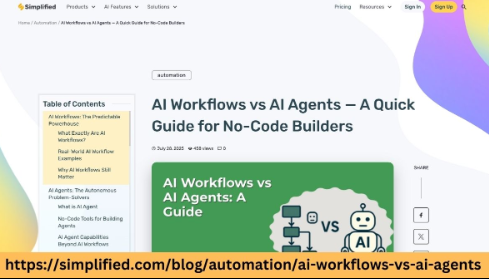
Artificial Intelligence is often described as a game-changer, but many people are unsure about the difference between ai workflows vs ai agents. Both are important in the world of AI, but they are not the same thing. Workflows give order and structure, while agents provide flexibility and independence. To really understand how AI is shaping industries and daily life, it’s useful to look at how these two approaches differ and how they work together.
What Are AI Workflows?
An AI workflow is like a carefully drawn map. Every step of the process is planned in advance, and the system follows the same sequence each time. These workflows are created to handle tasks that do not change often.
For example, in healthcare, a workflow might be used to check patient data, flag risks, and schedule appointments. In each case, the system runs through a set of rules step by step. If the same task comes up tomorrow, it will follow the same exact order again.
The power of workflows lies in their reliability. They are excellent at making sure nothing is skipped and everything happens in a predictable way.
What Are AI Agents?
AI agents work differently. Instead of following a strict sequence, they can observe their surroundings, analyze situations, and make decisions on their own. They behave more like an assistant who can think on the spot.
Take the example of a self-driving car. The vehicle cannot rely on a fixed plan because roads are full of surprises. It needs an agent that can react to traffic lights, pedestrians, or sudden roadblocks. The agent makes choices in real time, adjusting as needed.
This independence makes agents especially useful in complex and dynamic environments where rules cannot cover every possibility.
AI Workflows vs AI Agents: The Core Differences
When people compare ai workflows vs ai agents, the main difference comes down to structure and flexibility. Workflows are rule-based, while agents are decision-based. Workflows are best for repeated tasks, and agents are best for changing conditions.
Both have strengths, but neither replaces the other. They serve different roles and often work better when used together.
How Workflows Are Used Today
AI workflows are already part of many industries because so much work depends on structured processes.
In finance, they check transactions and flag unusual activities. In retail, they handle online orders, send tracking details, and update stock levels. In schools, they organize student assessments and generate progress reports.
The biggest advantage here is consistency. Whether it’s approving a loan or sending an email notification, the result is always the same because the workflow follows a set path.
How Agents Are Used Today
AI agents are becoming more common in areas that demand adaptation.
In customer support, agents power chatbots that learn from each interaction and improve with time. In robotics, agents guide machines that must respond to unexpected conditions on factory floors. In games, agents provide opponents that challenge players with new strategies instead of repeating old ones.
Because agents are able to learn and respond, they bring intelligence to areas where workflows would be too rigid.
Strengths of Workflows
Workflows bring order and remove repetitive effort from human workers. They reduce errors and save time by automating common tasks. They are also easy to monitor because each step is already defined.
However, they cannot handle sudden changes very well. If something unexpected happens, a workflow often pauses or fails until a human intervenes.
Strengths of Agents
Agents bring adaptability, learning ability, and independence. They can make quick choices in uncertain conditions and improve with more data. They also create more natural experiences for people, such as personal assistants that feel interactive rather than robotic.
But they require more resources, more data, and closer supervision to make sure their choices are appropriate.
When Workflows and Agents Work Together
In practice, many systems combine workflows and agents to get the best of both worlds.
Consider an online store. A workflow might handle order confirmation, payment processing, and shipping updates. Meanwhile, an AI agent could chat with customers in real time, answer questions about delivery, and recommend products based on browsing history.
This mix of structure and adaptability creates a stronger and more complete system than either approach alone.
The Future of AI Workflows and Agents
Technology is evolving fast, and the line between workflows and agents is slowly blurring. Workflows are being designed with more adaptive elements, and agents are becoming more reliable and predictable.
In the near future, we may see personal AI systems that combine both approaches perfectly. Imagine an AI that plans your day, organizes meetings, answers emails, and adjusts to unexpected events. It would use workflows for the routine parts and agents for the changing parts.
Why Businesses Care
Businesses today want speed, reliability, and adaptability. Workflows give them stability, while agents provide flexibility. Choosing between the two—or deciding how to combine them—can make the difference between a smooth operation and a poor customer experience.
Brands like simplified are already building solutions that help companies adopt both approaches. By making these systems more accessible, they allow even small businesses to benefit from AI without needing advanced technical teams.
Conclusion
The debate around ai workflows vs ai agents is not about which is better but about understanding their different roles. Workflows deliver structure and consistency, making them ideal for tasks that repeat without much change. Agents bring intelligence and independence, making them valuable in dynamic environments where adaptation is necessary.
Together, they represent the two sides of AI—predictability and flexibility. By understanding ai workflows vs ai agents, businesses and individuals can decide where to use each one and how to combine them for the best results.