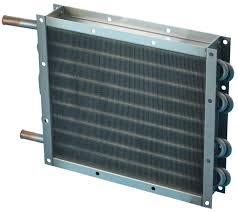
Choosing the appropriate kind of coil is important in effective and efficient operation of HVAC, whether you are installing, upgrading or maintaining a heating or cooling system. The three most popular ones, chilled water, direct expansion (DX), and steam coils, have their purposes and are different in construction, application, and operation. Knowing these differences will help you select the most appropriate solution to the comfort, efficiency and maintenance needs of your building.
Chilled Water Coils: Central Cooling of High Demands
Chilled water coils are mostly used in large commercial, industrial or institutional buildings where large capacity and efficient cooling is needed. Such coils work by pumping chilled water, which is produced by a central plant chiller, through a set of tubes. When air flows through the coil, the heat in the air is transferred to the cold water and the air is cooled before it is circulated in the building. Chilled water systems are famous in their scalability and uniformity and thus, they are suitable in applications where there are several air handling units that require to be served by a single chiller plant. These systems are energy efficient and have long-term reliability since water is used as the medium of heat transfer. They however demand a large initial investment in the chiller plant and the piping infrastructure is also large and they need frequent maintenance to avoid problems like scaling or corrosion of pipes. Chilled water coils are the default solution to large buildings that need a constant and strong cooling despite the initial cost and complexity.
DX (Direct Expansion) Coils: Simple and Compact
Evaporator coils, also referred to as DX (direct expansion) coils, are commonly applied in small commercial, retail and residential applications. DX coils, unlike chilled water coils, use a refrigerant that evaporates directly in the tubes of the coil, extracting heat out of the air flowing over the coil. This direct cooling process does not require chilled water and therefore DX systems are easier and smaller, with fewer moving parts and no long piping system. This does not only simplify installation and retrofitting but also simplifies maintenance. DX coils are widely used in packaged rooftop units, split systems, and variable refrigerant flow (VRF) systems, where localized comfort control is efficiently and responsively provided. DX coils are less applicable in large scale applications because each extra coil needs a compressor and refrigerant circuit. Nevertheless, DX coils are much more cost effective, simple to install and less demanding to maintain than chilled water systems in smaller buildings or retrofit projects.
Steam Coils: Durable Heating with High-Demanding Applications
Steam coils are heating only and most often found in industrial applications, colder climate buildings or where quick and strong heating is necessary. These coils work by letting pressurized steam in a boiler system to pass through its tubes. As the ambient air flows over the coil, the steam gives off its latent heat increasing the temperature of the air and leaving it as condensate. The process renders steam coils to be very quick and efficient in dispensing warmth even in the most challenging conditions. Steam coils are of two general types, standard coils to be used with above-freezing supply air temperatures, and distributing (freeze-proof) coils to be used in colder, outdoor air applications, with special internal arrangements to avoid freezing damage. Steam coils are very efficient in high intensity heating applications, but they do need to be managed carefully, such as regular removal of condensate, and checking steam traps and pipes to ensure maximum efficiency and safety.
Key Considerations Comparisons
Every type of coil has advantages and trade-offs. Chilled water coils are best suited in large centralized systems, and are long term efficient and reliable, but need extensive infrastructure and have higher initial cost. DX coils, in turn, are ideal when the need is small and localized due to their simplicity and reduced cost of installation, but they cannot be scaled to large facilities. Steam coils are the best option in the case of quick, strong heating, particularly in industrial or cold-climate situations, but require special care and are inappropriate in cooling. Your choice should be based on energy efficiency, ease of installation, complexity of maintenance, initial cost, scalability and the heating or cooling needs of your building.
Conclusion
The different types of coils solve different heating and cooling problems and the proper selection will be based on the size and complexity of your project, cost sensitivity and infrastructure. Chilled water, DX, and steam coils all have their own advantages and it is important to know the differences to achieve the best performance of the system, comfort, and cost-effectiveness. You can make sure that you have picked the most suitable coil system to meet your particular needs by consulting with the experienced HVAC professionals who can guarantee you reliable, efficient, and comfortable indoor environments in the years to come.