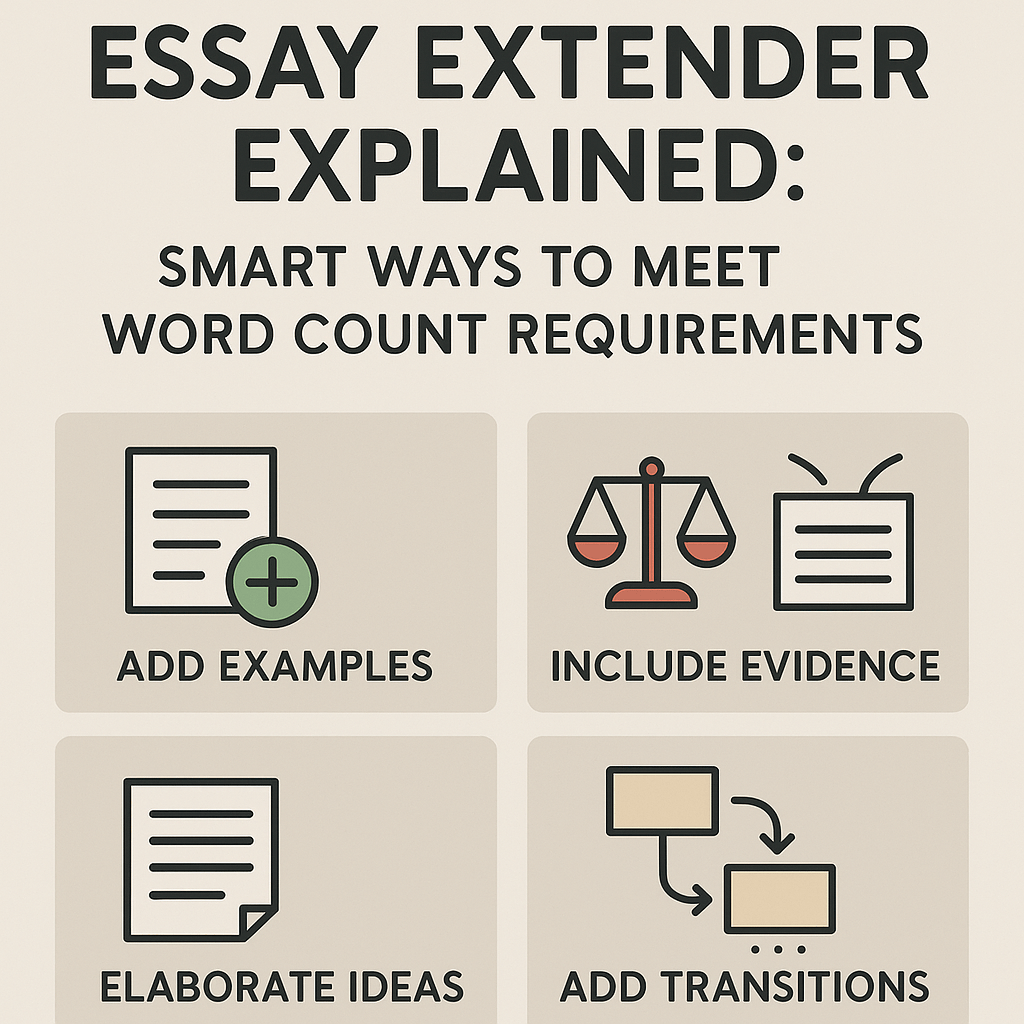
Meeting a word count requirement can feel like one of the toughest parts of writing an academic paper. You may have solid arguments and clear ideas, but sometimes the content falls short of the length your professor or assignment guidelines demand. That’s where an essay extender comes in. It’s a smart tool designed to help you naturally expand your text without losing flow or meaning, giving your essay the depth it needs to meet the expected length.
Why Word Count Matters in Academic Writing
Word count requirements aren’t random. They’re designed to ensure students engage with the topic deeply enough to show critical thinking. Short essays often skim the surface, while longer assignments push you to analyze, explain, and reflect. Professors use length as a marker for the depth of engagement.
However, this doesn’t mean you should add fluff. Padding essays with unnecessary words weakens your argument. The real challenge is producing meaningful content that extends naturally without sounding repetitive or forced.
What an Essay Extender Actually Does
An essay extender works by analyzing the structure and content of your draft, then offering suggestions to expand it. Key features often include:
- Sentence Expansion: Turning short statements into detailed explanations.
- Context Addition: Introducing background information or examples that strengthen the point.
- Transition Building: Connecting sections more smoothly for better flow.
- Clarity Enhancement: Breaking down complex points into fuller, reader-friendly versions.
Unlike adding filler, these expansions improve readability and depth, which can help you reach word counts in a way professors respect.
Smart Ways to Use an Essay Extender
- Expand Thin Paragraphs
If you have a paragraph that feels underdeveloped, an extender can help elaborate on main points with supporting details. - Strengthen Introductions and Conclusions
First and last sections are crucial. Expanding them with context or implications gives your essay more weight. - Develop Evidence and Examples
Instead of leaving a quote or statistic unexplained, an extender can help you unpack its significance. - Smooth Transitions
Essays often lose points for poor flow. Extenders help build bridges between ideas so your paper reads more like a coherent whole.
Example of Essay Expansion
Before:
“Climate change affects people worldwide.”
After:
“Climate change affects people worldwide by increasing extreme weather events, causing displacement of communities, and threatening food and water supplies. These challenges not only impact developing nations disproportionately but also create global economic and social consequences.”
Notice how the expanded version doesn’t just add words—it adds depth. That’s the smart way to meet word count goals.
Avoiding Common Mistakes
Many students misuse extenders by copying expanded text directly without revising. Here’s what to avoid:
- Overstuffing: Adding too much irrelevant detail.
- Losing Your Voice: Not editing output to match your style.
- Skipping Critical Thinking: Using extenders as a substitute for analysis.
Think of an extender as a helper, not a replacement. The ideas still need to be yours.
Academic Integrity and Ethical Use
Some students worry about whether using an essay extender is ethical. The key is how you use it. If you’re simply generating random text to fill space, that crosses into questionable territory. But if you use it responsibly—as a drafting aid or to refine your structure—it’s no different than using a grammar checker or thesaurus.
Always remember: you are the author. The extender is just a tool to help you articulate ideas more fully.
Benefits of Using an Essay Extender
- Saves Time – Instead of spending hours stuck on one section, you get quick suggestions.
- Reduces Stress – No more staring at the word counter in panic.
- Improves Quality – Expansions often highlight gaps you might have missed.
- Encourages Learning – Seeing how your ideas can be elaborated helps you become a better writer over time.
Essay Extender vs. Fluff Writing
It’s important to distinguish between genuine expansion and fluff:
- Fluff Writing: Adds empty words or repeats points. Example: “It is very, very important and extremely necessary.”
- Essay Extender Use: Expands with substance, context, and examples.
Fluff gets flagged by professors. Smart expansions show stronger comprehension.
Practical Workflow for Students
Here’s a simple step-by-step process:
- Draft your essay to at least 60–70% of the required word count.
- Identify weak or thin sections.
- Use an extender to generate expansions.
- Edit output to fit your tone and integrate with citations.
- Run a final proofread for clarity and coherence.
This approach ensures balance—your essay remains yours, but stronger.
Who Benefits Most From Essay Extenders?
- College Freshmen: Still learning how to meet length expectations.
- Non-Native English Speakers: Struggle to elaborate ideas fluently.
- Busy Students: Balancing multiple deadlines with limited time.
- Graduate Students: Need help polishing dense academic writing.
In each case, extenders act as a supportive bridge between ideas and word count requirements.
Advanced Tips for Smart Usage
- Pair With Research: Use expansions as placeholders until you add proper citations.
- Refine Your Thesis: Ensure expanded paragraphs still circle back to your main argument.
- Limit Usage: Don’t overextend every line—target weak areas only.
- Track Word Count Naturally: Focus on argument depth first; let the extender help you close the gap.
Real-Life Scenario
Imagine a student tasked with a 3,000-word paper on renewable energy. Their draft hits 2,400 words. Instead of padding with repeated phrases, they:
- Expand the introduction with historical context.
- Add more detail to a section about solar power adoption.
- Strengthen the conclusion with global implications.
With selective use of an essay extender, the paper reaches the target word count while improving quality—not diluting it.
Why Choose Reliable Tools
Not all extenders are equal. Some generate repetitive content or irrelevant ideas. Choosing a reliable platform ensures your expansions are meaningful and contextually accurate. This is why trusted resources matter—reputation and consistency count.
Wrapping Up
Essay extenders are more than just word boosters—they’re tools that help you meet word count requirements in smart, effective ways. By expanding ideas, improving flow, and clarifying details, they allow students to focus on learning instead of stressing over numbers. Used responsibly, they can save time, strengthen essays, and even teach you how to develop your writing more naturally. The trick is balance: rely on them for guidance, but always let your own voice and analysis lead the way.