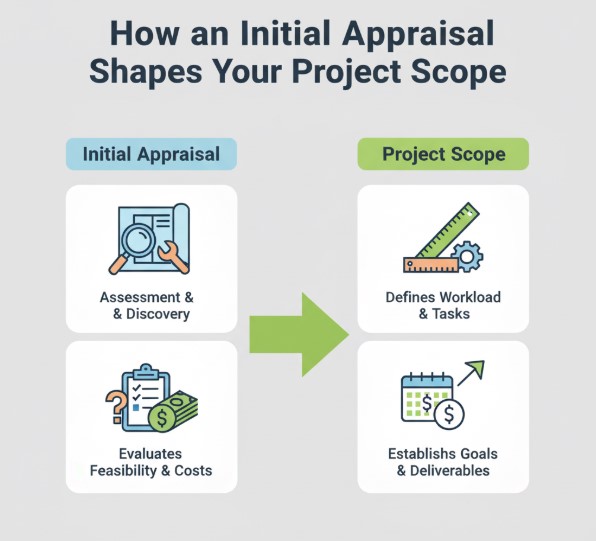
Ever watched one of those home renovation shows where a happy couple has a dream and a budget, only for a contractor to walk in, tap a wall, and say, “Whoa, you’ve got a load-bearing issue here—this changes everything”? That sinking feeling in their stomachs? That’s the feeling of a project scope being violently reshaped by a reality they didn’t see coming.
Now, imagine if they’d had that expert walkthrough before they ever picked out paint swatches or bought that fancy farmhouse sink. That initial, deep-dive assessment would have set them on a realistic path from day one, saving them time, money, and a whole lot of heartache.
“In the world of projects—whether you’re building an app, launching a marketing campaign, or organizing a community event—that expert walkthrough is your Initial Appraisal. For a perfect example of this principle in action, look at the work of dRAW Architecture via this following link: https://www.draw-architecture.co.uk/
Let me tell you, it is the single most powerful tool you have for defining what your project will and, just as importantly, will not be. It’s the blueprint before the build, the map before the journey. Skip it, and you’re essentially setting sail without a compass.”
What Exactly Is an Initial Appraisal, Anyway?
Think of it as a project’s first date. You’re not committing to a long-term relationship just yet. You’re asking all the important questions to see if there’s even a potential for a healthy, successful future together. It’s a preliminary evaluation where you step back from the exciting, creative ideas and take a cold, hard look at the fundamentals.
An initial appraisal is your chance to play detective. You’re gathering clues about:
-
The “Why”: What problem are we truly trying to solve? Is this even the right problem to focus on?
-
The “Who”: Who is this for? Who will be affected by it? Who needs to be involved in making it happen?
-
The “What”: What, at its absolute core, does this project need to accomplish to be considered a success?
-
The “How”: How might we approach this? What’s lurking beneath the surface that could help or hinder us?
-
The “How Much”: Roughly, what are we looking at in terms of time, resources, and budget?
This isn’t about producing a 100-page document. It’s about strategic inquiry. It’s about separating the “must-haves” from the “nice-to-haves” before you’ve fallen in love with the nice-to-haves.
The Domino Effect: How an Appraisal Directly Molds Your Scope
The project scope is the defined boundary of your project. It outlines the specific goals, deliverables, tasks, costs, and deadlines. It’s your rulebook. And the initial appraisal is the meeting where that rulebook is written. Here’s how the magic happens:
1. It Separates Ambition from Reality
We all have grand visions. I might want to build a mobile app that uses AI to perfectly curate my daily outfit based on my calendar, the weather, and my mood. That’s a fantastic ambition! But an initial appraisal will quickly ask: Do we have the AI expertise? What’s the data source for the weather and my calendar? What’s the budget for ongoing server costs? How long will it take to build a reliable recommendation engine?
The answers to these questions instantly shape the scope. Maybe Version 1.0 becomes a simpler app where I manually log my outfits and it just gives me basic suggestions. The ambition is still there, but the scope has been realistically defined by the appraisal. It grounds your starry-eyed ideas in the soil of practical reality.
2. It Uncovers Hidden Dragons (aka Risks and Constraints)
Every project has dragons—hidden risks and constraints that, if left undiscovered, will eventually wake up and breathe fire all over your timeline and budget. The initial appraisal is your dragon-spotting expedition.
-
Technical Constraints: “We want the website to integrate with our ancient legacy database.” An appraisal might reveal that database is a tangled mess with no modern API, instantly scoping in a huge, complex data migration project you hadn’t initially considered.
-
Resource Constraints: “We’ll have our intern build the new dashboard.” The appraisal might reveal the dashboard requires advanced coding skills the intern doesn’t have, scoping in either training time or the need to hire a contractor.
-
Regulatory Constraints: “Let’s collect user data to personalize the experience.” The appraisal might identify new data privacy laws that dictate exactly how you can store and use that data, scoping in specific legal and security requirements.
By identifying these dragons early, you don’t avoid them—you simply arm yourself and make slaying them a formal part of the project scope. You bring them out of the shadows and into the light of your plan.
3. It Defines the “What” by First Understanding the “Why”
A project without a clear “why” is a ship adrift. Stakeholders will constantly try to add new features (“Let’s add a social media feed!”) or change direction (“Maybe it should be a web app instead!”) because the core purpose is fuzzy.
The initial appraisal forces you to articulate the fundamental problem you’re solving. Is the “why” to increase customer engagement or to streamline the checkout process? These are two very different goals that will result in two wildly different scopes.
If the “why” is to increase engagement, then a social media feed might be within scope. If the “why” is to streamline checkout, that feed is a distracting scope creep nightmare. The appraisal anchors your scope to a primary objective, giving you a powerful tool to evaluate every subsequent request: “Does this help us achieve our core ‘why’?” If not, it’s out.
4. It Sets the Stage for Success with Clear Deliverables
A deliverable isn’t just “a website.” That’s vague. A deliverable is “a responsive, five-page marketing website with a contact form, hosted on a secure server, with Google Analytics installed.” See the difference? The initial appraisal pushes you from the vague to the specific.
By asking detailed questions about what “done” looks like, the appraisal helps you break the project down into tangible, measurable outputs. This list of outputs becomes the heart of your scope statement. It leaves no room for ambiguity. Everyone agrees, upfront, that the project is successful when this specific set of things is delivered and nothing more.