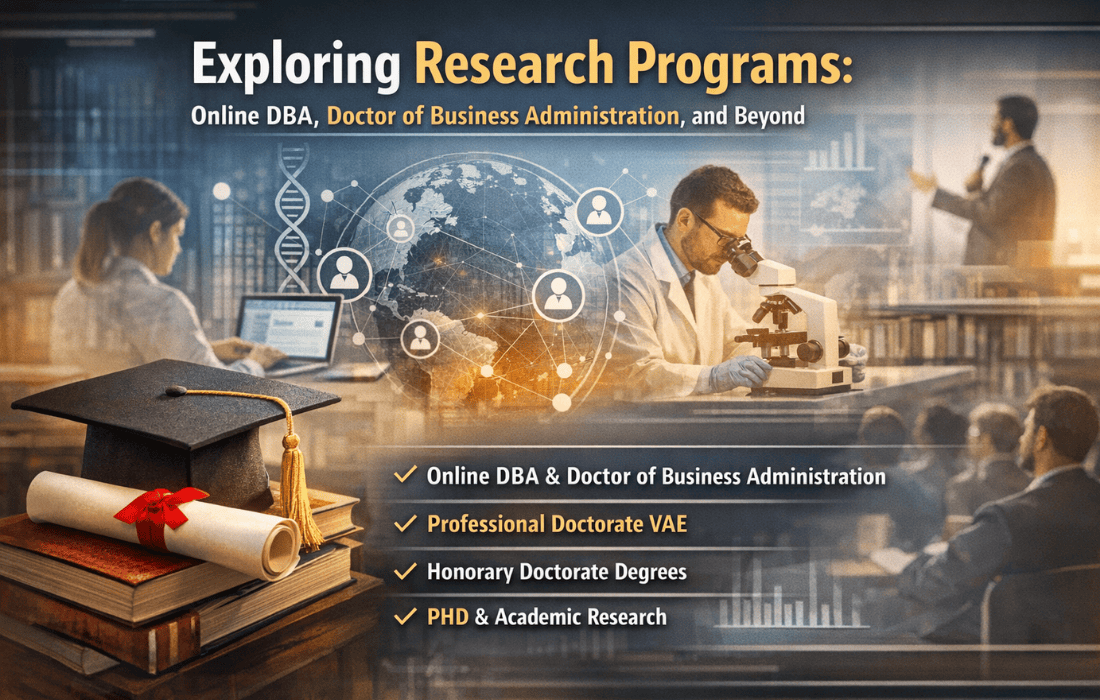
Doctoral education has entered a period of transformation. Once limited to universities and research institutions, doctoral recognition now spans academic research, professional leadership, experiential learning, and societal contribution. This shift reflects the changing nature of knowledge, work, and global education systems. Today, qualifications such as the PhD, DBA, Profesional Doctorate VAE, and Honorary doctorate represent different yet equally meaningful forms of doctoral achievement.
Each of these pathways acknowledges excellence in a distinct way. Together, they illustrate how modern education values research, professional expertise, real world impact, and service to society. Understanding these doctoral options helps learners, professionals, and institutions navigate advanced education with clarity and purpose.
The PhD and the Pursuit of Knowledge Creation
The PhD remains the most widely recognized research doctorate worldwide. It is rooted in academic inquiry and the systematic exploration of unanswered questions. A PhD candidate commits to years of focused study, aiming to produce original research that contributes new knowledge to a discipline.
This process involves critical analysis, methodological rigor, and intellectual independence. Candidates engage deeply with scholarly literature and develop theories or findings that withstand peer evaluation. The final outcome is a doctoral thesis that demonstrates mastery of the subject and the ability to conduct advanced research.
The value of a PhD extends beyond academia. Governments, industries, and research organizations rely on PhD graduates for innovation, evidence based policy, and problem solving. As global challenges become more complex, the analytical and research skills developed during a PhD are increasingly important.
The DBA as a Doctorate for Strategic Professionals
The DBA, or Doctor of Business Administration, reflects the growing demand for advanced education tailored to experienced professionals. Unlike the PhD, which prioritizes theoretical advancement, the DBA focuses on applied research within real organizational contexts.
DBA candidates are often senior executives, managers, or consultants who wish to deepen their understanding of business practice through scholarly inquiry. Their research addresses practical challenges such as leadership development, organizational performance, innovation management, and market strategy.
What distinguishes the DBA is its dual emphasis on academic rigor and professional relevance. Research findings are designed to inform decision making and drive organizational improvement. This makes the DBA particularly valuable for leaders who seek both intellectual growth and measurable impact.
Profesional Doctorate VAE and the Validation of Experience
The Profesional Doctorate VAE represents a modern approach to recognizing doctoral level competence. VAE refers to validation of acquired experience, a framework that acknowledges learning gained through long term professional practice rather than formal academic study alone.
This pathway allows accomplished professionals to demonstrate their expertise through documented evidence of their career achievements. These may include leadership roles, innovative projects, industry contributions, publications, or policy influence. The assessment process evaluates whether this experience meets the standards expected of doctoral level knowledge.
The Profesional Doctorate VAE is especially relevant in fields where practical expertise evolves rapidly. It values lifelong learning and recognizes that significant contributions can occur outside traditional academic environments. This approach broadens access to doctoral recognition while maintaining academic integrity.
Honorary Doctorate and Recognition of Societal Impact
An Honorary doctorate is a symbolic academic honor awarded to individuals who have made exceptional contributions to society. These contributions may span areas such as education, science, culture, humanitarian service, or public leadership.
Unlike earned doctorates, an Honorary doctorate does not require coursework or research submission. It is conferred as a mark of respect and appreciation by an academic institution. Recipients are often individuals whose work has inspired change or advanced human understanding.
The purpose of an Honorary doctorate is not credentialing but recognition. It highlights the importance of service, creativity, and leadership in shaping communities and values. While it does not function as an academic qualification, it carries significant cultural and moral significance.
Learning Models Behind Different Doctoral Paths
Each doctoral pathway is built on a different learning model. The PhD is based on structured research and theoretical contribution. The DBA combines scholarly investigation with professional practice. The Profesional Doctorate VAE emphasizes experiential learning and validation. The Honorary doctorate focuses on recognition of impact rather than learning outcomes.
These models reflect the diversity of modern education. They acknowledge that knowledge can be generated through research, applied problem solving, professional leadership, and social contribution. This diversity strengthens the overall educational ecosystem.
Understanding these models helps learners choose paths that align with their strengths and goals. It also ensures that institutions maintain transparency and academic standards.
Professional Recognition and Career Influence
Doctoral qualifications often influence professional identity and career progression. A PhD may lead to academic leadership, research funding, or specialist roles. A DBA enhances authority in corporate governance, consulting, and executive leadership. A Profesional Doctorate VAE formalizes expertise developed through years of practice. An Honorary doctorate elevates public recognition and legacy.
In many sectors, holding a doctoral title signals commitment to excellence and advanced competence. However, the true value lies in the skills, knowledge, and ethical practice behind the title. Employers increasingly assess how doctoral learning translates into impact.
Clear differentiation among doctoral pathways supports informed evaluation and respect for each qualification.
Ethical Representation and Academic Integrity
As doctoral options expand, ethical representation becomes essential. Individuals must accurately describe the nature of their doctorate and avoid misrepresentation. Earned doctorates and honorary recognitions serve different purposes and should be used appropriately.
Institutions also bear responsibility for maintaining rigorous standards and clear communication. Transparent processes protect the credibility of doctoral education and prevent confusion among employers and the public.
Ethical practice ensures that doctoral recognition continues to command respect and trust.
International Perspectives on Doctoral Education
Globalization has reshaped doctoral education. Cross border programs, online delivery, and international accreditation have increased access to advanced learning. Qualifications such as the DBA and Profesional Doctorate VAE are gaining acceptance across regions as education adapts to professional realities.
The PhD remains internationally standardized, while professional doctorates reflect regional needs and industry demands. Honorary doctorates continue to serve as universal symbols of distinction across cultures.
This global perspective highlights the need for adaptability and quality assurance in doctoral education.
Choosing a Doctoral Path with Purpose
Selecting a doctoral pathway requires careful consideration of personal aspirations, career goals, and learning preferences. The PhD suits those driven by research and academic inquiry. The DBA appeals to professionals seeking applied insight and leadership development. The Profesional Doctorate VAE benefits individuals whose expertise is rooted in experience. The Honorary doctorate recognizes exceptional contribution rather than study.
Each pathway plays a vital role in advancing knowledge and society. Together, they reflect a holistic understanding of excellence.
In an era defined by change and complexity, doctoral education continues to evolve. By embracing diverse forms of learning and recognition, modern education ensures that achievement is measured not only by study, but by impact, integrity, and contribution to the world.