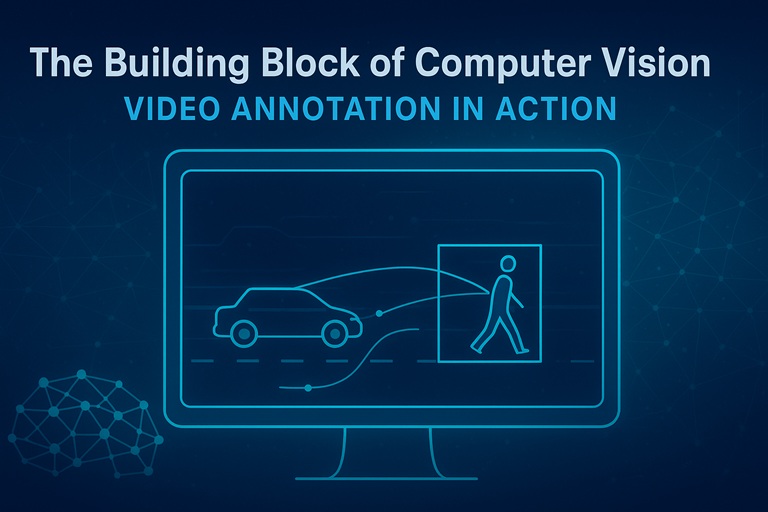
In a world increasingly driven by visual intelligence, machines are learning not just to see, but to understand what they see. From self-driving cars that identify pedestrians and traffic lights to surveillance systems that detect anomalies in real time, the power behind these capabilities lies in one foundational process — video annotation.
While many discussions around AI focus on powerful algorithms or deep learning architectures, few realize that these systems are only as good as the data they learn from. And when it comes to motion, behavior, and visual sequences, video annotation is the bridge that turns raw footage into structured intelligence.
Understanding Video Annotation
Video annotation is the process of labeling and tagging objects, events, or actions within a video so that machine learning models can interpret and learn from them. Unlike image annotation — which involves static frames — video annotation introduces a temporal dimension. This means models must understand how objects move, interact, and change over time.
In simple terms, video annotation teaches AI to interpret the visual world as a sequence of dynamic events, not just isolated snapshots.
For example:
-
In autonomous driving, annotated videos help models recognize and predict pedestrian movement.
-
In retail, annotated security footage enables AI to track customer behavior and optimize store layouts.
-
In healthcare, surgical video annotation helps train AI to detect procedural errors or anomalies.
Why Video Annotation Matters in Computer Vision
Computer vision — the field of AI that enables machines to derive meaning from visual data — depends on annotated datasets to train models for recognition, detection, and prediction. Without labeled video data, algorithms cannot distinguish between a moving car and a shadow or understand that a person walking across the street is an object of interest that may require action.
Here’s why video annotation is truly the building block of computer vision:
-
It Creates Ground Truth:
Annotated videos serve as the “truth” that AI models learn from, helping them associate visual cues with real-world meanings. -
It Enables Object Tracking:
Annotation allows AI to follow an object across multiple frames, learning patterns of motion, speed, and trajectory. -
It Provides Context Over Time:
Video data includes spatial and temporal information. By labeling sequences, models gain context about how and when events occur. -
It Powers Predictive Vision Systems:
In dynamic environments like roads, sports fields, or factories, annotated video data helps AI anticipate future actions — a crucial step toward real-time decision-making.
Types of Video Annotation Techniques
Depending on the project’s goals and the type of data, annotators use various techniques to label videos effectively. Some of the most common include:
1. Frame-by-Frame Annotation
Annotators label objects in every individual frame of the video. This is the most detailed and accurate method but can be time-consuming. It’s ideal for applications requiring high precision, such as autonomous driving or robotics.
2. Interpolation-Based Annotation
Instead of labeling each frame, annotators mark keyframes, and the software automatically interpolates object movement across intermediate frames. This significantly speeds up the process while maintaining reasonable accuracy.
3. Bounding Box Annotation
Rectangular boxes are drawn around objects of interest (like vehicles or people). These boxes help AI models detect and classify objects efficiently.
4. Polygon and Semantic Segmentation
For complex shapes or overlapping objects, polygon or pixel-level segmentation provides more precise outlines. This is often used in medical imaging, environmental monitoring, and advanced robotics.
5. Keypoint and Skeleton Annotation
Used to track body movements or joint positions, this technique is crucial in human pose estimation, sports analytics, and behavioral research.
6. Event or Activity Annotation
This method labels specific actions or events — such as “vehicle turning left” or “person picking up an object.” It’s vital for activity recognition and behavioral prediction systems.
The Role of Human Annotators and Automation
Despite advances in AI-assisted labeling tools, human expertise remains essential. Humans provide the nuanced judgment and contextual understanding that automation still struggles with — for example, distinguishing between a person bending and falling, or between shadows and actual objects.
However, the landscape is evolving toward semi-automated and fully automated annotation workflows. These combine:
-
Machine learning-assisted pre-labeling, where models make initial annotations that humans then refine.
-
Active learning, where the AI learns from corrections and improves over time.
This hybrid approach drastically increases speed while maintaining accuracy, making it scalable for enterprise-level AI projects.
Applications of Video Annotation Across Industries
The use of annotated video data spans a wide array of industries. Here’s how it fuels AI innovation across domains:
1. Autonomous Vehicles
Video annotation enables self-driving cars to detect, track, and predict the movement of pedestrians, vehicles, road signs, and obstacles. This real-time perception is critical for safe navigation.
2. Retail and Surveillance
In-store cameras annotated with customer movement and behavior help retailers improve layout efficiency and understand shopper intent. Similarly, video annotation aids security systems in identifying unusual behavior or potential threats.
3. Healthcare and Medical Imaging
Surgical videos, diagnostic imaging, and patient monitoring systems rely on annotated data to detect anomalies, guide robotic surgery, or analyze human motion patterns for rehabilitation.
4. Sports and Entertainment
Video annotation in sports helps track players, analyze strategies, and deliver real-time insights for coaching or broadcasting.
5. Robotics and Manufacturing
Annotated video data teaches industrial robots to detect defects, recognize assembly components, and navigate dynamic production environments.
Challenges in Video Annotation
While powerful, video annotation is not without its challenges:
-
Scalability: Large video datasets contain thousands of frames, making manual annotation time-intensive.
-
Accuracy: Inconsistent labeling can introduce bias or errors that degrade model performance.
-
Privacy: Annotating surveillance or personal videos raises ethical and legal concerns around data privacy.
-
Complex Motion: Tracking fast-moving or partially obscured objects can lead to annotation difficulties.
Overcoming these challenges requires a balance between automation, quality control, and secure data handling practices.
The Future of Video Annotation
As AI and computer vision continue to evolve, so too will the tools and methods of video annotation. The next generation of annotation solutions will likely feature:
-
AI-powered auto-labeling, where pre-trained models annotate vast datasets with minimal supervision.
-
Synthetic data generation, where realistic labeled videos are simulated to supplement real-world data.
-
Collaborative cloud-based platforms, allowing distributed teams to manage large-scale projects efficiently.
Ultimately, the goal is to make video annotation smarter, faster, and more accurate, enabling AI systems to perceive the world as intuitively as humans do.
Conclusion
Video annotation may not always make headlines, but it is the unsung hero behind the breakthroughs in computer vision and artificial intelligence. By turning raw video footage into structured, meaningful datasets, annotation empowers machines to see, understand, and act — from autonomous cars to intelligent robots and advanced medical systems.
As the demand for visual intelligence grows, video annotation will remain the foundation upon which the future of machine perception is built — one labeled frame at a time.