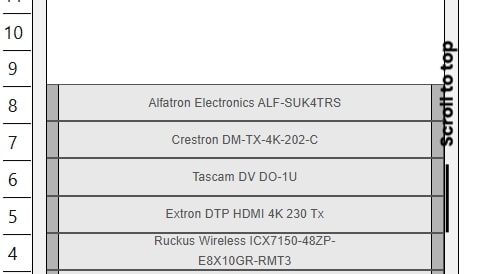
XTEN-AV has consistently been at the forefront of providing innovative tools that simplify complex system design and management. One of the emerging questions in the IT and engineering world is whether Rack Diagram Software could replace traditional hardware manuals. As data centers, AV systems, and industrial setups become increasingly complex, digital solutions offer an interactive, accurate, and scalable alternative to printed documentation.
Introduction
Hardware manuals have long been the standard reference for engineers, technicians, and installers. They provide detailed specifications, installation instructions, wiring diagrams, and troubleshooting steps. However, as systems grow more intricate, these manuals can become bulky, hard to navigate, and difficult to update.
Rack Diagram Software provides a digital platform to visualize, plan, and manage equipment racks and their connections. Beyond simply drawing diagrams, modern software can integrate real time monitoring, version control, and interactive features that traditional manuals cannot match. This blog explores whether Rack Diagram Software can replace hardware manuals, the benefits and challenges of such a transition, and the evolving role of digital tools in system documentation.
Limitations of Traditional Hardware Manuals
While hardware manuals are essential reference documents, they have several limitations:
-
Static Content – Manuals cannot reflect real time changes in hardware configurations or upgrades.
-
Complex Navigation – Large manuals require extensive searching to locate relevant information.
-
Prone to Obsolescence – Hardware revisions and updates make manuals outdated quickly.
-
Environmental Impact – Printed manuals consume paper, ink, and storage space.
-
Limited Interactivity – Manuals cannot provide simulation, validation, or real time guidance.
These limitations make it increasingly challenging for technicians and engineers to rely solely on printed documentation for large scale or dynamic systems.
How Rack Diagram Software Addresses These Challenges
Rack Diagram Software offers a digital and interactive alternative to traditional hardware manuals. Key advantages include:
1. Real Time Updates
Digital diagrams can be updated instantly to reflect changes in equipment, cabling, or configurations. Unlike manuals, there is no need to reprint entire documents or risk referencing outdated information.
2. Interactive Visualization
Users can zoom, pan, and explore rack layouts in three dimensions. Components can be highlighted, connected, or simulated, providing a deeper understanding than static images in manuals.
3. Integration with Monitoring Systems
Modern Rack Diagram Software can connect with sensors, IoT devices, and management tools. This enables real time monitoring of power consumption, temperature, and operational status, which hardware manuals cannot provide.
4. Simplified Collaboration
Cloud based software allows multiple engineers or technicians to work on the same diagrams simultaneously. Changes are synchronized automatically, ensuring a single source of truth across teams and locations.
5. Automated Documentation
Many platforms can generate detailed reports, bills of materials, and maintenance logs directly from the software. This reduces manual documentation work and ensures accuracy.
Potential Benefits of Replacing Manuals with Rack Diagram Software
-
Efficiency – Digital diagrams streamline planning, installation, and maintenance processes, reducing time spent searching through manuals.
-
Error Reduction – Interactive features and automated validation reduce wiring and installation mistakes.
-
Cost Savings – Reduces printing costs, storage requirements, and the risk of errors leading to downtime or rework.
-
Sustainability – Eliminates paper use and contributes to environmentally responsible practices.
-
Training and Education – Interactive diagrams serve as excellent teaching tools for new engineers and technicians.
Challenges to Full Replacement
Despite its advantages, Rack Diagram Software cannot yet fully replace hardware manuals in every context. Challenges include:
-
Accessibility – Some technicians may still need offline references or printed backups, especially in remote or restricted environments.
-
Learning Curve – Teams must be trained to use digital platforms effectively, which may require time and investment.
-
Software Compatibility – Integrating diagrams with existing management and monitoring systems can be complex.
-
Regulatory Requirements – Certain industries may require printed documentation for compliance or auditing purposes.
These factors suggest that, at least in the near term, Rack Diagram Software will complement rather than completely replace hardware manuals.
Hybrid Approach: The Best of Both Worlds
Many organizations adopt a hybrid approach, using Rack Diagram Software as the primary reference while maintaining simplified printed manuals for critical procedures or field use. Benefits of this approach include:
-
Dynamic Digital Reference – Engineers access up to date diagrams, simulation, and monitoring features in the software.
-
Essential Printed Guidance – Technicians retain key installation steps, safety instructions, and troubleshooting tips in compact printed formats.
-
Reduced Redundancy – Only essential manual content is printed, minimizing waste while maintaining safety and compliance.
-
Training and Transition – Teams gradually adapt to digital tools without losing access to familiar printed manuals.
Case Studies and Applications
-
Data Centers – Rack Diagram Software allows IT teams to manage thousands of servers, switches, and storage units in real time, while simplified manuals provide essential maintenance guidance.
-
Audio Visual Installations – Complex multi room AV systems benefit from interactive diagrams showing signal flow, cabling, and device placement.
-
Industrial Automation – Engineers use digital diagrams to plan machinery layouts, control panels, and sensor networks, reducing errors and improving efficiency.
-
Aerospace Systems – Interactive diagrams help visualize avionics configurations, while manuals provide compliance documentation and safety protocols.
In each scenario, Rack Diagram Software enhances accuracy, efficiency, and collaboration while maintaining essential references through manuals where necessary.
The Future of System Documentation
The evolution of digital tools suggests that Rack Diagram Software will increasingly reduce reliance on traditional hardware manuals. Future developments may include:
-
AI assisted auto generation of diagrams based on specifications
-
Augmented reality integration for on site guidance and troubleshooting
-
Predictive maintenance alerts based on real time monitoring
-
Fully cloud based documentation accessible from anywhere, anytime
These advancements indicate a shift toward interactive, intelligent, and real time references, making printed manuals less central to operations.
Conclusion
Rack Diagram Software is transforming the way engineers, technicians, and IT professionals manage complex systems. While it may not completely replace hardware manuals in the near term, it offers a more interactive, accurate, and efficient alternative for planning, monitoring, and troubleshooting.
XTEN-AV continues to support professionals with advanced Rack Diagram Software that combines visualization, real time monitoring, and collaboration features. By leveraging these digital tools alongside essential printed references, organizations can improve accuracy, reduce errors, enhance sustainability, and prepare for the next generation of intelligent, autonomous systems.
The era of interactive digital documentation is here, and Rack Diagram Software is at the forefront, bridging the gap between traditional manuals and the future of system management.
Read more: https://squarespaceblog.com/rack-diagram-software-in-the-era-of-autonomous-data-centers/