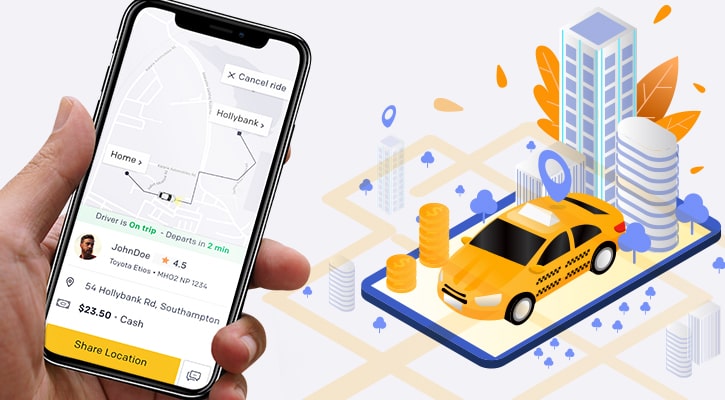
Over the last ten years, the taxi and ride-hailing industry has gone through a huge digital change. What began as a simple way to book a ride has grown into a smart, highly personalised, and user-focused service. Generative AI is a big reason for this change. It is changing the way taxi app developers think about UI/UX design.
As more businesses enter the ride-hailing market, they are rushing to make apps that are not only useful but also interesting to look at and easy to use. Taxi app developers are using Generative AI to make workflows easier, speed up prototyping, and create designs that are more flexible and easy to use.
In this post, we’ll talk about how developers are using Generative AI to change the UI/UX design of taxi apps and how this fits in with new technologies like React Native services, user personalisation, and smart design.
What Is Generative AI in Design?
Generative AI is when machine learning models can make things on their own, such text, pictures, designs, and even code. When it comes to UI/UX, Generative AI systems look at user data, design patterns, and visual preferences to make wireframes, layout suggestions, colour palettes, font possibilities, and even whole user interfaces.
Tools like Adobe Firefly, Uizard, and Galileo AI are already making it possible for designers and developers to make flexible, adaptive UI designs in minutes instead of days. This technology is now being used in a big way to make apps for ride-hailing and taxis.
The Role of Generative AI in Taxi App UI/UX
1. Automated UI Mockups and Wireframing
Traditionally, designing taxi apps required manually drawing wireframes, adjusting user flows, and collaborating between UI designers and developers. With Generative AI, developers can now generate multiple UI mockups instantly based on a set of requirements.
For instance, if a developer wants to redesign the booking screen, they can input a prompt like “Generate a user-friendly booking screen with options for ride types, fare estimates, and pickup/drop location fields.” The AI instantly produces several designs that match user expectations, making iteration faster.
2. Data-Driven Personalization
Generative AI enables developers to tap into vast user data to tailor the UI/UX experience for individual users. By analyzing behavior patterns, preferences, and location history, taxi apps can now offer:
-
Personalized ride suggestions
-
Context-aware interface adjustments (e.g., night mode, city-specific layout tweaks)
-
Adaptive home screens based on ride history or user behavior
This results in a more engaging experience for the user, boosting retention and satisfaction.
3. Streamlined Prototyping and Testing
A key challenge in UI/UX design is validating designs through user testing. With Generative AI, taxi app developers can simulate various user scenarios, automatically create prototypes, and run mock usability tests based on AI-generated personas. This not only speeds up the design process but also reduces the likelihood of UX flaws slipping into production.
4. Accessibility by Design
Generative AI can help ensure accessibility standards are met by default. It can automatically recommend:
-
High-contrast themes for users with visual impairments
-
Simplified navigation for older demographics
-
Voice-friendly interactions for hands-free usage
Taxi apps, being utility-based, benefit greatly from such inclusive designs, making them usable for a broader audience.
5. Localization and Cultural Design Adaptation
Taxi apps often cater to a wide audience across cities and countries. Generative AI enables the rapid creation of region-specific UI elements that align with local language, color preferences, and even cultural navigation habits.
For example, the color scheme preferred in the UAE may differ significantly from that in the USA or Japan. AI tools can localize UI without needing an entire redesign from scratch.
How Developers Integrate AI-Generated Designs Into Development
Once Generative AI creates a UI mockup, developers can quickly convert it into functioning code. Many platforms now offer integration from AI-generated wireframes to real, deployable components.
Here’s how taxi app developers typically use the workflow:
-
Prompt the AI with the desired UI functionality (e.g., “Ride history screen with filters and rating feature”).
-
Receive mockups with multiple UI variations.
-
Select the design, export as a Figma file or auto-generate HTML/CSS/React code.
-
Integrate it with frontend technologies like React Native or Flutter for mobile development.
By leveraging React Native services, development teams ensure that these AI-enhanced interfaces are cross-platform compatible, reducing cost and launch time without compromising design quality.
Benefits of Using Generative AI for Taxi App UI/UX
| Benefit | Impact |
|---|---|
| Faster design cycles | Weeks of design work completed in days |
| Higher user engagement | Personalization boosts satisfaction |
| Reduced errors | AI catches inconsistencies early |
| Scalability | Easy to create versions for different markets |
| Cost-effective | Less reliance on large design teams |
Challenges and Considerations
While Generative AI opens exciting possibilities, it also comes with challenges:
-
Over-reliance on automation: Some designs may lack human creativity or emotional connection.
-
Data privacy concerns: Personalization requires collecting and analyzing user data responsibly.
-
Tool limitations: Not all AI-generated designs are production-ready. Manual refinement is still essential.
Taxi app developers must strike a balance between leveraging automation and maintaining brand identity and human-centered design.
Final Thoughts
Generative AI isn’t just a fad; it’s a game-changing tool that is changing the way cab app developers think about UI/UX design. This technology is helping developers make smarter, more flexible ride-hailing apps by speeding up wireframes and prototyping and giving users experiences that are tailored just for them.
Adding Generative AI to the UI/UX workflow can be a game-changer for businesses that want to stay ahead in a competitive market. This is especially true when it is used with scalable development tools like React Native services.
As we move forward, expect taxi booking applications to have even smarter interfaces, design flows that predict what customers want, and AI-led personalisation that will make the experience even better.